1,500 Index Cards
Unearthing ANOTHER Lost Gaming Technology

A(nother?) Misunderstood Method
How do you tell when nobody knew anything about a given piece of lost gaming wisdom? That’s easy. Look at what they aren’t saying when a given topic comes up. Even better, look at how they reframe the extraordinary to fit in with accepted “business as usual” type norms.
James Maliszewski does precisely this with M.A.R. Barker’s 1,500 character cards.
Now, I don’t mean this as a slam. I really like James. I think he loves old rpgs the way I love old rpgs. He ran the flagship blog of the OSR for a great many years. And more than anyone else, he brought the concept of megadungeons back down from the attic, dusted it off, and then did things with the concept that nobody else had imagined or dared to try. Sure, some people will claim that they knew about megadungeons before he popularized them and made them accessible. And yeah, you could nitpick him on some of his creative choices. But the fact remains, he reopened a door that had remained closed for a long, long time. And he moved the state of the art in rpg’s forward.
But seriously, go back and look at his Monday, February 15, 2021 post, “Index Cards”. I could quote the whole thing, but I’ll just summarize it:
1) Wistfully recall an original campaign setting he created as a kid and for which he developed a couple hundred NPC’s.
2) Quote a passage from Tony Bath’s book Setting Up a Wargames Campaign.
3) Allude to M.A.R. Barker’s astonishing 1,500 index card NPC file.
4) Call out the salient point of Bath and Barker’s gaming to be that they “[keep] track of vital – in the most expansive sense – information for the campaign.”
5) Observe that having a big file of NPC cards is really useful when you run a long rpg campaign because you “[won’t] need to create a NPC from whole cloth on the spot but could instead pluck a suitable one out of [your] file”
Now, why would I say that James Malizewski missed something big here? Because he writes almost fully within the framework of what we call conventional rpg play. Effectively, he looks back at Bath and Barker who were both doing something intrinsically different from what the rpg hobby became after about 1980 and instead rushes to the conclusion that, “they’re just like me for real, for real.”
But Barker and Bath weren’t anything like ANY of us at all. They lived in an entirely different world and had entirely different assumptions about gaming. They didn’t just work up a tremendous pile of npcs. “NPC” perhaps isn’t even the right term for these characters at all! The characters were not merely static data to be referenced in game sessions. They were, in a very real sense, active participants in the campaign in their own right. By going through these cards every three months or so and updating them by rolling on some Tony Bath tables, Barker effectively set up a unique kind of living world campaign. They existed in a very real sense for their own sake. They would grow and change and develop and “experience” things even while the players are away from the table for many months.
That last bit may sound like old hat to you today, but I can tell you that it wasn’t always that way. Roleplayers don’t just randomly fail to have any active game elements in their campaigns apart from the players. Many of them are actively opposed to anything happening in the campaign apart from the activities going on in the vicinity of a sort of “spotlighted” party of adventurers. The assumptions and most accepted practices within rpgs from the period of about 1980 to 2020 actually preclude the possibility of anything growing or changing or developing while the players are away from the table. People are deeply and weirdly and passionately opposed to the idea just on principle and would really like for these games to work practically any other way.
It’s a tough pill for a lot of people to swallow, but M.A.R. Barker’s 1,500 character cards are only especially interesting once they are hooked into a system of strict timekeeping where the campaign calendar moves forward somehow more or less in step with the real world calendar. The concept of time was intimately connected to his efforts. We know this because of the rules which he wrote into Empire of the Petal Throne in 1975.
James Maliszewski wasn’t the only person to miss this connection in his analysis. Steve Jackson did, too, back in the mid-eighties. When he developed the GURPS rpg line, he did not see Barker as having a game where he’d created countless independent characters developed over time in such a way as to create a legitimate living world, a sprawling sort of social megadungeon. He instead saw what could be the basis of an entire product line where the game world had so much gratuitous setting detail that it could be packed up into an effectively infinite series of game supplements. A consequence of this was that for many years, the whole idea behind the GURPS system was that its game masters would let Steve Jackson Games do the heavy lifting with more or less realistic and generic rules systems so that they could instead focus their efforts on making a unique and fully realized game world. Remnants of the old timekeeping rules from the seventies ended up getting tucked away into the earliest editions of the GURPS game master rules and even the idea of delegating key “adversary” NPCs to non-party players in order to bring those roles to life. But this concept of having the NPCs become independently active en masse is nowhere to be found.
Traveller came closer. The board wargame Fifth Frontier War rules included an intriguing suggestion to have players adventure within the overall broad brush situation presented by an ongoing Firth Frontier War game. But the concept of a strict timekeeping system is nowhere to be found in the Traveller rules outside of an odd suggestion for solitaire play in a stray JTAS article. One could imagine a referee leveraging the year-by-year career development system of the game’s Advanced character generation rules to painlessly maintain records for a large number of Traveller characters in real time in a 1:1 time campaign. Even so, such an effort would be far different from what M.A.R. Barker was doing. In spite of the fact that Traveller includes a concept of a Three Musketeers style interstellar nobility overseeing a sprawling mass of quasi-independent worlds, the sort of random life event tables devised by Tony Bath and which Barker may have thought that “everyone” would “naturally” know about are nowhere to be found in any of the game’s iterations.
The Bathian Distinction
And it’s an odd thing, too, because Jack Vance’s Cadwal Chronicles is less about the actions of individual characters than it is about the development of half a dozen families over relatively long spans of time. Dune is no different. And it is not just these relatively high brow works where this is the norm. The first order of business for any Edgar Rice Burroughs protagonist is of course to start a family. And the utterly ubiquitous Harry Potter series makes a relatively big deal about the commingling of the Black and Malfoy family trees. I don’t have to mention Frodo’s relation to Peregrin Took as a similar anchor point. Nor do I have to mention, say, the sort of shenanigans that could introduce a Mordred into a story. Or, for that matter, an Arthur.
This is an odd omission for the rpg hobby to collectively make, especially when it was so hung up on getting the details right on so many other things. Of course, I am not saying that Bath and Barker’s assumptions about campaign play were completely unknown to everyone in the world, including your wargaming uncle in Canada. But I am saying that Bath’s and Barker’s notions of what a continuing campaign even is has been well outside of the mainstream for many decades now— in both tabletop rpgs and in tabletop wargaming. Collectively, we have a blind spot when it comes to the sort of things Bath and Barker took for granted.
I have no doubt that you can find some counterexamples to the generalizations I have made here. And maybe it’s true. Your uncle in Canada and maybe an entire game line or game form maybe somehow preserved the Bath/Barker approach to gaming while everyone else got distracted by the necessities brought on by having to seriously and deeply work out just precisely how shotgun damage should actually work in an rpg. Good on you! But I suspect there are going to be many more rules passages to be found that very curiously fall short when it comes to encouraging people to think the way that those two early pioneers of gaming did.
Consider this passage from page 104 of the 1979 Dungeon Masters Guide as a key sort of touchstone in these matters:
SITUATION 1 (S1) is where encounter occurs for the first time, and while the party inflicts casualties upon the monsters, victory is denied; the party then leaves with its wounded, regroups, and returns one full week later to finish the job. SITUATION 2 (S2) is where the party, rested, healed, and ready for action, has now re-encountered the monsters in question. In both situations the response of the monsters concerned will be detailed so you can use the examples in handling actual play.
The two page spread containing this excerpt details how the referee should work out how a significant NPC group will react when a previously repulsed party returns to visit them one week later. I love this section of the rules! It is really helpful in breaking down in clear detail what monsters and npcs actually do in response to the players’ actions. Even better, it fits with the VERY COMMON PATTERN that emerges when tables utilize a “one real week equals one game week” timekeeping system, an open table, and player-directed campaign activity. All good things for a serious open ended D&D campaign. For most people playing in most old style D&D campaigns, following the model given on these pages is the quickest way to get them to begin to experience something like a living fantasy world. And it goes much deeper than the now run of the mill OSR advice we have all heard over the past couple of decades to intermittently “allow” dungeons the chance to restock themselves from time to time.
But again, notice what is NOT there. All of these monsters and stronghold examples could very well have come from interactions with entirely random wilderness encounters that were rolled up on the spot during the heat of play. It is as if these creatures only came into existence in response to the players stomping around a hex map. It is as if the referee only has the haziest of notions of what is going on in the broader world. It is as if the random tables are accepted as being completely sufficient to give the same overall impression as an actual running model of a fantasy world would give.
Most assuredly, you can play a lot of D&D for a very long time without ever feeling a need to work up 1500 NPC’s and then go through them every three months to find out who got married, who inherited a barony and who has just become a grandfather. But is there advice about something like that tucked away in some Greyhawk or Forgotten Realms supplement? I couldn’t tell you. Maybe Gary Gygax wrote something like that himself somewhere in a book of dungeon mastering advice, I don’t know. Either way he isn’t famous for it. He is much more famous for putting together three volumes of monster entries and then providing dozens and dozens of random encounter tables to give you an absolute most appropriate encounter for any conceivable dungeon level or terrain type.
What are the consequences of this? A lot of campaigns where nothing really changes or develops or grows unless a group of player characters is directly engaged with it. This is a really odd outcome, if you ask me. And in some ways it is perhaps even contradictory to the very concept of a “campaign”. That may be pushing it pretty far, but I think there is something to that.
And I already know what you are going to ask now. If the Bath/Barker method of campaign management was so great, then why would it virtually disappear from the hobby? I hypothesize that perhaps maybe the first wave of referees that used 1:1 time and gave large numbers of players full autonomy to do whatever they wished were so overwhelmed by the amount of activity in their games that they largely stopped caring about anything in the campaign world that wasn’t actively being controlled by a player. Through habit, happenstance, or even conviction, some of these people would even go so far as to insist that NOTHING in the campaign existed until it was instantiated into play by either a real player or via a random encounter table.
Of course I am biased about all this. And I am actually telling you there what I observed when we were tinkering with the Trollopulous campaign over a span of several years. But I suspect Braunstein style play really did displace the Bath/Barker approach because its greater dynamism sapped the energy that would have been invested into the older form of play. Braunstein play sustained more engagement with less investment. Then later on when the hobby expanded to accommodate a vast number of non-wargaming fantasy fans, the first order of business of these new arrivals would have been to address what they saw as a conspicuous absence of setting detail… which they addressed over time by ignoring rules entirely, enforcing setting coherence from the top down with little regard for either the game rules or player autonomy, or else developing overwrought game procedures that couldn’t actually scale to handle the needs of a bona fide campaign.
To be sure, if just a few months ago you had taken the overall sense of Bath and Barker’s methods, taken their names and the lore of their games and players out of the matter, and then maybe even bragged about doing just the sort of things that they did, I would assuredly have insulted you for wasting so much time on an effort of pointless rpg prep and insisted it would most assuredly fail to see much use at the table. The pressures of keeping up with active Braunstein style play in real time are just that intense!
But times have changed. Half a dozen crack game referees have developed techniques like SEEN which make Braunstein dynamics easier to manage– that distribute the workload out to the players in a more sustainable and coherent way. The art of Braunstin play has advanced to such a point that we now have the luxury of entertaining just exactly where and how and why Tony Bath and M.A.R. Barker’s approach to campaign management could actually be useful.
I will preface my speculations by saying that I seriously doubt that I will ever run a campaign on top of 1,500 index cards representing as many distinct and active N.P.C. characters. I doubt I would even have the stamina to match the attention span of a very young James Maliszewski who would easily handle 200. Running forty would be plenty for my own tastes, but that is rather underwhelming I’m sure. I’m sure you could easily outdo me. Of course, that would only be due to you extraordinarily barren social calendar!
On the other hand, that kind of effort isn’t entirely foreign to my table, either. I did work up 30 NPC’s for the Moonstein sessions. I very dutifully worked through the Book 1 and Supplement 4 tables just to see what would emerge from them. I would try to produce certain types of characters which I really desired to play and then very often I would end up with something entirely different. Then as situations would arise in play, I would dip into these cards in order to “people” various emerging situations. Sometimes these characters would stick around for only a session or two. And sometimes, the nature of scenarios would be heavily influenced by who and what remained within my deck. Ultimately, my deck of thirty cards would not be enough. When I needed to know the exact stats of the crew of a Yacht, I would dig through the pages of Supplement 1. When I kicked off the first Moonstein game, I used nearly every single Baron that was provided by the sample characters list from Supplement 4. (I even took a page from Tony Bath and named them all with names I had pulled from a random Appendix N book.)
But the deck of thirty NPC’s were special. While they couldn’t serve the needs of EVERY situation that could arise when you have a dozen characters loose within the same Traveller setting, the exact stats on the cards and the personalities implied and life histories by them would have an outsized impact on the major players that arose to contend with the player characters. Who is running the dojo that is a cover operation for the weird space drugs? Who is at the estate of the space noble that is attempting to coax the players into a dangerous mountain expedition? What are the stats of the sword expert that will duel with Dubs when he bullies his way into a China Town style water rights scenario that never once crossed my mind when I was thinking of all of the things that the players might get involved with? The answers to these sorts of questions weren’t in the lists of NPC stats in Supplement 1 or Supplement 4. Instead they were in among all of those characters were the ones that I had rolled up myself in precisely the same manner that the players would have done it: by the book, choice by choice, and with real dice at a real table.
I say all of this not to brag about my brilliance as a referee, but rather to emphasize how my instincts are nothing like those of M.A.R. Barker. In some ways, the rules and tables of the Traveller game highlight how the very concept of the game precludes Bath/Barker type thinking. The character generation rules, for instance, produce characters that have completed their careers. Only people that have experienced involuntary early retirement have the latitude and/or the impetus to even be TRAVELLERS– to be player characters even. Only that class of people have the level of autonomy necessary to be worthy of being handed over to a player to be run within a game. But the campaign characters that M.A.R. Barker maintained in his gigantic rolodex did not require that kind of freedom.
The Bath-Barker approach to managing a campaign opens up play to a side of the Traveller universe that most people running the game would ignore or handwave or abstract out entirely from the details of the ongoing campaign. Call me crazy, but this is I think analogous to how the rediscovery of 1:1 time opened up the rest of the campaign world to allow everything else within the campaign world besides the player characters to finally get a turn to play, to finally get a chance to react and move and think and respond.
How do I know this…? Well look at what happens when you start tinkering with Barker’s approach. For instance, I always thought that the characters that died should somehow be accounted for within session play. That they should be relevant to the players’ developing lore. It never happened in practice. A referee is much too harried to circle back to such things in my experience. Even if the index cards of people that died in character generation didn’t go straight to the garbage can, nothing about those characters ever ended up having any impact on anything that occurred in the Traveller campaigns that I participated in.
But if I had 1,500 Traveller characters being generated incrementally year by year in real time with the Advanced Character Generation rules from Books 5-8 and the Alien Modules, I would have plenty of time to leverage such things. If each of those characters had a name and a family and brothers and sisters and a lineage and a chance to inherit a particular estate on a particular world and they were all part of various competing cliques and factions and then ANY of them died per the survival rolls... well... there is potentially a bit of intrigue there. There is something about tracking all of these characters together over time that transforms the death in character generation rules into something more than just a kind of governor that puts a limiting factor on people that want to push their luck to get more skills, better attributes, better careers, and more benefits. Suddenly you have a unique sort of context where what would have otherwise been just a throwaway random outcome becomes something you and your countless alter egos invest a great deal of thought and emotional energy.
Granted, it would be possible to write a computer program to produce a million such characters. For my tastes, I would argue that you should do it by hand and not just because that would put a limit on the amount of raw data that you could conceivably dump onto your campaign efforts, either. There is, too, an oracular power to the dice. The way they turn up for a particular character in a particular circumstance matters and not just for spooky supernatural reasons. Your brain needs time to make a story out of it. You need time for apophenia to kick in and for your abductive reasoning to generate something compelling enough that you would care enough about it to keep up with it when players are stomping around the galaxy and looking for trouble.
Would something better come of this than whatever a referee could make up by the seat of his pants? You know, I don’t know. The worlds of Moonstein and Madriguerra really did spring to life in response to the efforts of so many individual characters operating independently and in the same place under a very narrow timespan. The Bath/Barker techniques would I think be ideal for creating something potentially alive and meaningful in a gameplay region that the BrOSR would have previously categorized as being mere “diffusion”. And the introduction of lineage as family ties as a primary feature of the gameworld focus would allow for a more distributed treatment of what up until now we have called a faction.
One thing I do know is that if I was undertaking anything of the sort, my table would necessarily become much less open. I would be much more particular about who I let into the game and I would have way higher standards for what kind of ideas could be let into the continuity. Maybe I would be so particular, I would keep the game entirely solitaire forever. Or maybe the players would reject it because there would be much more of a limit on how much they could influence the state of the game universe. And if I did it at all, it would only be because I fully expected to run it to the exclusion of all other games for many, many years.
That doesn’t sound like me at all. And yet... there is plenty to wonder about here. Could it really work? Would it bring something to the table that other campaign management methods can’t?
There is only one way to find out.
Incorporating Bath’s Techniques
How different would it be from other approaches to setting up a campaign? In some ways it would be no different at all. In others, it might stand every assumption we lapse into completely on its head. Does it matter whether a campaign newsletter is generated entirely from solo activity rather than from the antics of 30 to 50 independent players? The techniques you use to work up a set of rumors and news reports and bits of library data detailing your overall campaign state would be no different either way.
But the real difference would really come down to how player characters as a class are viewed in relation to the campaign as a whole. In standard rpg campaigns, the active player characters are primary by default and npc’s come in and out of play based on their relevance to the interests of the players. In a Bath/Barker style Advanced Traveller campaign, the campaign characters would remain persistent regardless of whether players are concerned about them or not. And it would be the player characters that would come in and out of play– that would fade into the background noise of the vastness of the campaign setting when the players played poorly or intermittently or only briefly.
Could I care about the fates and activities of hundreds of campaign characters in the event that nobody else had any interest in them at all? Or would something click eventually the way that it did in M.A.R. Barker’s Tékumel campaign that would cause players to be engaged with something much more ambitious than a single pawn or playing piece given free reign to wander about on a hex map? Is it possible in this decade with everything else that has happened and that is going on to outright replicate the kind of results that Barker’s players reminisce about to this day?
Again, we won’t know for sure until someone does it.
How would I do it, though? Let’s brainstorm. Here is my current plan:
Begin with a minimum of 40 active campaign characters developed from the Book 4-8 and Alien Module “advanced” character generation systems at varying stages of process. (I.e., they are all different ages and have not yet fully mustered out.)
Layer in additional events related to marriage and child birth. As I think on this, there is no reason to do quarterly passthroughs of the index cards. Yearly checks for significant social events like marriages and childbirths should be sufficient.
Move them forward a year in the character generation procedures at the end of each real year.
Read a lot of Traveller antecedents. Distribute worlds and situations from these books on a subsector map.
Randomly generate other worlds and begin to nail down one or two subsectors worth of worlds.
Use the extended stellar planetary tables from Book 6 Scouts to flesh out a few of the star systems.
Distribute the campaign characters across this map. Imagine what they are doing. Each time you review a campaign character’s circumstances, determine where they would have moved to. If there is any chance to move them to a remote location within a star system, take it– this will be the first time in rpg history that anyone actually used complicated random planetary system tables for actual serious gameplay.
Place the estates of various noble families among the game worlds you have begun to detail.
Look at all of the activity within this campaign and look for points of conflict between worlds and campaign characters and the various situations you have placed into the game from the source literature. Seize any opportunity for convergence. Generate news entries and library data based on these connections.
As you review your campaign character cards on a quarterly or yearly basis, note their involvement with any known convergence. Err on the side of incorporating them. (The campaign characters are not just completely random and representative people of the setting. They are the people that are especially likely to be involved with intrigue much more than anyone else.)
Ignore every other Traveller supplement and rpg product in existence.
Invite people to roll up Traveller characters and then muster out into this new milieu.
Run the game in the type II sessionless Braunstein manner. When campaign characters and player characters encounter each other, anonymize the interactions so that they don’t know if it’s a real person that is interacting with them or an NPC or campaign character. (Credit: Serious DM )
If a player gets especially excited about either an NPC or a campaign character, go out and find somebody to take over the play of this character temorporily or permanently. (Credit: Serious DM )
Produce a public news entry to cover any significant stunt or adventure shenanigans that any player or group of players get involved with. (Credit: Serious DM )
Maintain local news logs for individual worlds that can be accessed only by adventure style rumor gathering activities.
And again, you can ask if this is really that different from what anyone else did that ran a Traveller campaign. But I would say it is. Most people playing Traveller got too distracted by the “official” game setting to actually set up a serious original campaign setting. (See Ken Pick’s “A Tribute to the Burgess Shale Period of Traveller” for details of this.) Most people playing Traveller were unfamiliar with the game’s literary antecedents. And while High Guard campaigns on a couple of subsector maps are not unheard of, Braunstein-style play with the Traveller game is something that has been modestly explored only over the past few years.
But I do think that all of this is new. The more I think about this, the more persuaded I become. And what’s more, these procedures solve problems that absolutely stymie aspiring Traveller referees.
Consider the idea of generating homeworld in tandem with the usual character generation procedures which I think debuted with the release of the MegaTraveller rules. The idea that “where you are from” should influence how things turn out in your career seems like it should be a good one. In practice, these rules result in maybe a bonus here or there or perhaps a couple of background skills. There was so much potential here, but things really haven’t evolved beyond that dumb Secondary Skills Table from page 12 of the Dungeon Masters Guide.
Now, you could brute force this. You could roll up a subsector and then work up a percentile table that gives you a random person’s home world based on the population ratings for each world you are looking at. (Ken St. Andre did something similar for his Stormbringer rpg. It’s pretty cool.) But this is nevertheless not particularly useful. You are left trying to wrap your head around a dozen worlds at once. Your ability to make sense of the data is stretched to the limit. Only the most patient and dull sort of person would be able to continue pushing forward with this sort of effort. Even if they succeeded in getting something with this brought to the table for an actual game session, I doubt they would be any fun to play with.
But seriously, for most people it’s going to work easier going from the bottom up rather than the top down. If you give me a subsector listing of a bunch of worlds, my eyes glaze over. I can get lost going down a rabbit hole of JTAS articles that expand on what each individual world code really means. I struggle to keep up with what the steadily compounding increase of raw data. And if I look at those in the context of a bunch of GURPS supplements, the standard for interpretation jumps up to the PHD level.
Meanwhile, if you give me a group of players doing whatever they want on a world that was rolled up on the spot, the whole place just springs into a kind of shared reality effortlessly. This is a side effect of a combination of collective apophenia, unflinching abductive reasoning, and the superior alloy brought about by the injection of your best friends’ personalities into the game setting. It works. I think you can leverage the same play dynamics even when you operate solitaire in the Bath/Barker mode. I think not grasping that this is possible is why so many of my efforts to prep Traveller campaigns collapsed over the years.
Consider the following Scout character created with Book 6:
STR 11, DEX 4, END 4, INT 8, EDU 6, SOC 9
Not admitted to college.
Age 18: Enlisted into The Field. Office Assignment: Survey. Initial training: Pilot-1
Age 19: Mission. Killed.
Well, that’s the Traveller Scout Service for you. Uh… well… let’s try again with this fellow’s younger brother.
STR 7, DEX 9, END 6, INT 12, EDU 14, SOC 9
Arbitrarily setting this guy’s SOC to 9 to match his family. Because a family has just been implied by our play efforts.
College: Graduates with honors. Enters the Scout bureaucracy.
Age 22: Initial Training: Admin-1
Age 23: Base Assignment
Age 24: Routine Duty – Gain Forgery-1
Age 25: Base Assignment
Age 26: Specialist Training – Increase to Admin-2
Age 27: Routine Duty
Age 28: Mission – Advance to O2
Age 29: Intelligence School – Gain Streetwise-2
Traveller rank of 1 is less than the # of terms served. CANNOT REINLIST!
Benefits: Cr 60,000 and +2 Intelligence
Now, we already have something pretty good here. Let’s say the first character was five years older. We have several worlds that we need to nail down now. Sure, we can do the homeworld for these two guys. Maybe that could add some color, sure. But what is really interesting is what happened to get the first guy killed. What hex on the subsector map did that happen in? Who else was involved in that situation? And the younger brother…. Where specifically is the base that he was assigned to where his career went to die? Was anyone plotting behind the scenes to bring this about? Was some other family pulling strings to make sure that this one was cut off from a promising career? And what exactly was going on that this guy was turned into some sort of spy at the very last moment of his second term?
As you roll up more worlds and characters, these questions will begin to get answered. You almost can’t help yourself. All you need is time to wonder. But you don’t know what the dice will give you. It helps, though, to go ahead and make a timeline:
2009 – Brother A enlists into the Survey office of The Field.
2010 – Brother A Killed while on a mission
2014-2017 – Brother B graduates college with honors.
2018-2021 – Brother B placed in a dead end career via base duty with the Detached Scouts.
2022-2025 – Brother B gains sketchy intelligence school training just before his Scouts career expires.
Once anchored in a specific time and place, these characters become much more interesting. Tony Bath said, “while much of [this character data] may never be used, you will be surprised at how much of it can come in useful at times.” I think it is already useful. For one thing, I have a vague plot in my mind about all of this that more or less fits the outlines of Raymond Chandler’s The Long Goodbye. The mystery will only deepen as other characters enter play that have direct and tangential connections to these events. Instead of looking at the task of rolling up the worlds of an entire subsector, I am instead excited to find out more about the locations where the major events of these two characters’ lives transpired.
It’s a given that there will be a character that was in the Field while brother A was around and who then later transferred to the Bureaucracy when brother B was trying to make his mark. But who knows! Maybe the dice will give me something even better before such a person can spring from the advanced character generation tables.
We have time. After all, there is only 1,499 more of these to go…!
The Nature of the New Campaign
It is rather difficult to find a stopping point for this effort. I do want to keep tinkering! Prepping the campaign is now something that uses precisely the same techniques that we use when we play the game. These are no longer distinct activities. When you have played your campaign into existence, then there is zero chance of you prepping rpg material that never gets used!
This seems so natural, I have to wonder if I really in fact never did this before. But I do think that we are undertaking campaign efforts in a way that stands in stark contrast to the advice that many of us have leaned upon. Consider this passage from the Dungeon Masters Guide:
Your campaign requires the above from you, and participation by your players. To belabor an old saw, Rome wasn’t built in a day. You are probably lust learning, so take small steps at first. The milieu for initial adventures should be kept to a size commensurate with the needs of campaign participants — your available time as compared with the demands of the players. This will typically result in your giving them a brief background, placing them in a settlement, and stating that they should prepare themselves to find and explore the dungeon/ruin they know is nearby. As background you inform them that they are from some nearby place where they were apprentices learning their respective professions, that they met by chance in an inn or tavern and resolved to journey together to seek their fortunes in the dangerous environment, and that, beyond the knowledge common to the area (speech, alignments, races, and the like), they know nothing of the world, Placing these new participants in a small settlement means that you need do only minimal work describing the place and its inhabitants. Likewise, as player characters are inexperienced, a single dungeon or ruins map will suffice to begin play.
I think this is a sound approach for most people most of the time: start with only the most minimal amount of preparations, get players playing within a tiny fragment of a game world, use random tables to cover for all of the things you haven’t prepared, and then stay just enough ahead of your players that they never fully appreciate just how much you are faking it.
Oh, but who am I kidding? THEY KNOW. And if they are anything like my friends, they prefer gaming in an unprepared world because it means they can more easily experience actual play autonomy. What’s more, their most devious jokes at the referee’s expense are liable to be canonized into the campaign’s lore…. It’s fun. It’s brilliant. And it is unlike anything that Tony Bath and M.A.R. Barker were doing before the publication of original D&D.
What do I mean by that? Well, note this passage which also shaped our assumptions about how rpgs work much more up until now than anything produced by Bath and Barker:
Unlike most games, AD&D is an ongoing collection of episode adventures, each of which constitutes a session of play. You, as the Dungeon Master, are about to embark on a new career, that of universe maker. You will order the universe and direct the activities in each game, becoming one of the elite group of campaign referees referred to as DMs in the vernacular of AD&D.
It is very subtly implied in these sentences that the campaign is a function of the individual game sessions. It is almost as if the game world would not exist at all if the players didn’t show up to care about it.
Of course, someone especially familiar with the old Dungeon Masters Guide might simply suggest that all we need to do is keep reading and we will see that Gygax says this:
In short, you will have to create the social and ecological parameters of a good part of a make-believe world. The more painstakingly this is done, the more “real” this creation will become.
But is that it, really? Is this our evidence that Gygax is telling us the exact same thing that Bath and Barker outlined? Hey, maybe he was even paraphrasing Tony Bath in that very sentence there! But I don’t think he successfully articulates how people not already familiar with Bath and Barker’s work could replicate their processes. The tables and tools and advice on how to make it happen simply isn’t there.
Now, I do not want to detract from the power of players having fun to bring things to life just by engaging with the most nakedly minimalistic amount of prep. Take a single Traveller world code, set up the flimsiest excuse for a Braunstein on it, and in no time the place will take on a magical sort of coherence. The place will seem real. Not just to the referee, but to everyone that has become invested in the outcome of the developing situation.
Every conflict that is adjudicated between two or more player characters in that wide open and barely sketched out environment causes countless very small questions about the world to be asked and answered. You barely even notice it as it happens, but the answers to each question influence how other questions are answered and even influence what kinds of questions get asked. When various threads begin to converge into more audacious situations with even higher stakes, the flavor of the game world becomes extraordinarily specific. At the end, every single decision that was made by anyone in the heat of play gains an air of inevitability. Decisions and results that came about early on that were made without any context whatsoever get reinterpreted to fit with the things that happened later on. A sense of narrative and subreality that is so strong, one could hardly want to put much effort into prepping any kind of campaign whatsoever.
Gygax subtly points us in this direction and it is a danged good idea. He equips us to succeed with this sort of effort. And even more intriguingly, he suggests that a sequence of game sessions is the ultimate source of the real meat of a campaign. But Bath and Barker offer us something different. I think they offer us a way for us to set up a living campaign before the referee offers anyone a seat at his table.
Synthesizing Braunstein and Bath
Let’s see if we can leverage something like the dynamism of Braunstein play to stand up a much more ambitious campaign world than the spartan town and dungeon setup that most of us cut our teeth on.
There is not a hard and fast procedure to do this. In fact, I don’t think there should be an explicit procedure. Sometimes I will just make decisions about the campaign world in order to put in place things that I know must be there. Some of this derives from the process of using abductive reasoning to work out why a set of random tables gave me what they did. But other times when I am completely lost and have no idea what to do, I might consult some random tables to dare them to give me something that is better than anything I could work out with my own creativity. Still other times, I will make up entirely new random tables because nothing exists which solves a particular problem I face.
First up, let’s see if the youngest brother got accepted into the Scout service.
STR 7, DEX 6, END 8, INT 4, EDU 5, SOC 9*
No college. Enlists into the Scouts. The Field. Communications Office.
Age 18 / 2026 – Initial Training: Pilot-1
Oh, he’s in! And now I have something to look forward to for next year.
And now, some random worlds:
A564464-B Naval Base, Gas Giant [Home world of brothers A, B, and C]
C644388-9 Scout Base, Gas Giant [Location where brother B’s scout career went to die. Legitimately boring backwater.]
D766555-5 Scout Base, Gas Giant [Some kind of dangerous frontier area where brother A was sent to die… after the fashion of David and Uriah. Use Book 6 to flesh out the system details and determine the exact location of his death.]
Now… where did Brother B go when he mustered out? Is he involved in some kind of freelance intelligence activity or is he just an extremely well-educated criminal now? What kind of family would stake its fortunes on the Scout service? Why would someone pull strings to cut them out of a modestly successful life?
And how would Tony Bath have begun answering these sorts of questions? We actually do know some details about this. And this is kind of crazy, but… he would have worked through all this by doing something akin to a Tarot reading.
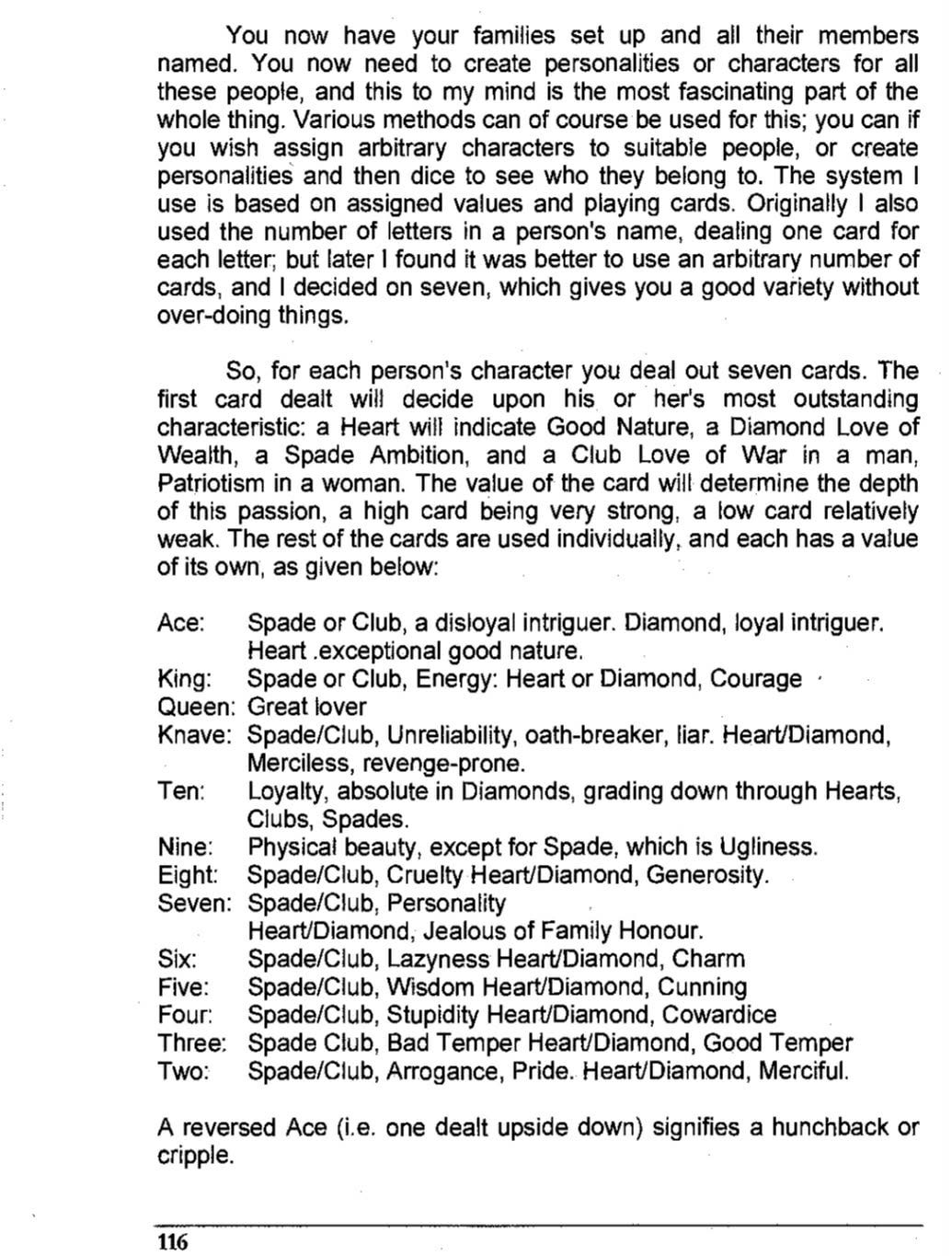
Let’s do a simultaneous reading for the two brothers that are still active in the campaign environment:
Brother B: 5 ♣, J ♥, 10 ♣, 9 ♥, 2 ♦, 8 ♣, Q ♠ – Moderate love of War – Merciless/Revenge-prone, Fairly Loyal, Good Looking, Merciful (?), Cruel, Great Lover
Brother C: J ♦, 10 ♠, 8 ♥, K ♦, J ♠, 10 ♦, 3 ♠ – Extreme love of Wealth – Marginally Loyal, Generous, Courageous, Unreliabiliity/Oathbreaker/Liar (?), ABSOLUTE LOYALTY (!), Bad Temper
Holy cow!
I really have to say this now… but Tony Bath really knew what he was doing. Notice how these characters– this family even– is beginning to come to life.
Everything just popped in my imagination all at once. Not only did something bad happen to Brother A, but these two guys are dead set on paying back whoever is responsible. Brother B is a dashing Domic Flandry type. Brother C is… well… he is a bit more unstable. He is so absolutely loyal to something, he would break an oath for it. (?!) Had he been in another career, he could have been a Dr. Yueh type. He us utterly fastidious and completely reliable… except where one particular leverage point is concerned.
Notice how superior this system is to, say, the point-buy system of GURPS to work through a shopping list of advantages and disadvantages. Notice how it is even so much more coherent than the random tables Gygax put together in the Dungeon Masters Guide to address the same general need. Traveller characters already somehow pick up a lot of personality by the time they muster out. This is true even for the nameless strings of digits that you find in Supplement 1. But combined with Tony Bath’s tables…? They are even better.
Not NPCs. Campaign Characters.
But assuming we were going to roll on some tables like what M.A.R. Barker was using to check in with these guys for the summer this year… what would that look like? I haven’t the faintest notion. If M.A.R. Barker actually published the tables he was using, it was absolutely to no fanfare at all that he did. Something that should have been written about at length in game magazine articles. I should already have a book like this on my shelf. I should already know about this. I shouldn’t have to hit up Crossface and have him give the skinny on a vast sea of gaming lore that nobody knows anything about but which three weeks from now the entire world will insist they have always known.
Maybe I don’t want to know all the gory details about what was going on in the wargaming world back in the nineteen sixties. Maybe I just want to enjoy wondering about this for a little while. After all, would would rpgs be if there were no longer some metaphorical Everest to climb?
Before we speculate about how we might manage the more personal details of a very large mass of rpg characters over a very long span of time, though, let us take a look at how a significant component of the Bath/Barker approach to campaign management fared in the hands of the premier publisher of science fiction rpgs of the 1980’s: GDW.
Traveller: The New Era actually includes a descendent of Tony Bath’s playing card system which I believe they first debuted with the release of Twilight: 2000. (And note that Twilight: 2000 filled such a desirable niche so well that its rules would ultimately be used as the basis for all of GDW’s rpg systems. It became a house system with a more or less “realistic” rules platform which would have been in direct competition for what Steve Jackson was aiming to accomplish with his GURPS game system.)
The first thing we will note is that the Traveler: New Era rules talk a big game when it comes to NPCs:
NPCs are nonplayer characters. Note the emphasis on characters. The only difference between a PC and an NPC is that a player plays the first and the referee plays the second. Perhaps a better term would be RPC, for referee-played characters. These individuals should be potentially as realistic and interesting as any player character, for it is these NPCs that make Traveller’s universe real for the players. Players want to go places and meet interesting people, and it’s up to the referee to make those people interesting.
I can’t tell you how my heart lifts when the game authors introduce this idea of referee-played characters. This should be a paradigm shifting concept. What if… there were characters in the campaign world that were in some real sense playing the same sort of game as the players…? Wouldn’t that be something? But the gameplay described here cannot escape the confines of conventional rpg thinking. The point given here for having realistic nonplayer characters is to better engage the players. The NPCs here do not exist for their own sake nor do they get to “play” in the campaign in any significant sense.
“But Jeffro,” you might object. “Aren’t you reading a great deal into this tiny little passage?” No, I am not. Consider this:
A detailed NPC is one that is created by the referee using the character generation system in just the same way that a PC would be created. A detailed NPC should be created when the NPC is someone with whom the player characters will be interacting on a detailed or regular basis. Examples of this sort of person are the PC’s main opponents in an adventure or campaign, a crewmember aboard the PCs’ ship, an important colleague or ally, or a patron (see the “Patrons” entry on page 63). Many solid contacts (see “Character Generation”) developed by the PCs during play should also be created as detailed NPCs.
The detailed NPC is only developed when the player characters can expect to have a lot of interactions with them. Nothing significant happens outside of the immediate attention of the players. Even the players’ adversaries only exist for the purposes of a planned scenario or set of linked game sessions. Nothing like the wildness of Braunstiein-style play is implied by these passages. Neither is there any hint of the sort of sprawling social mega-dungeon of Barker’s Tékumel campaign.
The Bath/Barker approach to managing and developing a campaign was as lost in 1993 as it was in 2021 when James Maliszewski was contemplating it.
Strategic Overview
So what now?
We have a new toy to play with and a rather ambitious project to tackle. I don’t think we can fully appreciate as yet all of the possibilities of Tony Bath and M.A.R. Barker’s approach to managing a campaign, but I do think I can offer right now a few maxims to guide experiments in this direction.
Control the impulse to think of how you have already implemented Bath/Barker techniques in previous campaigns. Instead focus on things you have not done before and reflect on how you would do things differently if you attempted to lean into their way of thinking.
A campaign character does not exist to produce data, situations, and a sense of verisimilitude only for the purposes of keeping players engaged and entertained. They exist as if they are “playing” them within the campaign environment for their own sake.
Develop families, not individual characters.
Create timelines for a family that covers decades and multiple generations.
Use abductive reasoning to imagine Braunstein scenarios that could have resulted in the more dramatic events of the timeline.
When playing out the “now” for a large batch of campaign characters, do not merely use random tables to create even more suffocating quantities of procedurally generated data than Traveller campaigns already have. Do not reflexively seek out more data than you can assimilate or that players could possibly care about. Instead look for any significant conflict that could develop between characters or families and imagine it as a game that is actually being played.
When a character is faced with a decision for how he will respond to these kinds of multi-directional prisoner’s dilemmas, use the Tony Bath playing card personality features to create custom d6 and d12 reaction tables that fit with both the character and the situation.
Use the results of these reaction tables to imagine how events would play out. Nail down the event outcomes by incorporating salient points of the conflict into library data, news entries, and facts that could only be picked up via rumors.
Traveller is focused primarily on the adventures of the transient. Bath/Barker play in Traveller campaigning is focused on noble families and their estates.
The Traveller SOC now perhaps becomes the most significant stat in the game. High SOC may even be indicative of high social cohesion and the ability to maintain strict traditional social mores. Female characters might, for instance, need to roll over the SOC score in order to reinlist at the end of a term.
Players in more standard rpg sessions do not necessarily have to interact heavily with campaign characters. It’s a big universe. If they choose not to engage with them and instead want to tackle something completely random… let them do it. They can adventure in a universe where you have already asked and answered a lot of the same questions that will come up as they pursue their interests. The real question is… can they come up with anything that you will want to continue to maintain and develop year over year the way that you already do with your campaign characters?
No doubt more about this fascinating play method will be uncovered as people begin to experiment with it more. But the timescale and scope of these experiments are much larger and much more ambitious than what most people are currently attempting. We have already faced the difficulties of developing new rpg techniques in the context of the year-long test cycle that is an inevitable feature of experiments with long running campaigns. Bath-Barker techniques by definition tackle an even larger test window.
The BrOSR has up until now dismissed extravagant campaign prep out of hand as being intrinsically uninteresting to players who would likely have ten or a hundred times as much fun pulling off an off the wall ruse in a ridiculous Braunstein event. It is I think time to ask the same question that the rediscovery of 1:1 time posed the rpg scene. Does the world need to get a turn to play when the players don’t show up to the table for several weeks? Or now, rather… should other characters in the game world get a turn to play before the players even show up at all?
Tony Bath and M.A.R. Barker thought so. And weirdly, people haven’t given this matter any significant thought at all over the past forty-six years. I think it is past time to revisit these questions– especially in light of the discoveries and practices that the BrOSR has developed in this decade.
Incorporating Player Plans
A couple of side effects of this procedure are immediately evident even at this early stage. For one thing, a referee operating hundreds of characters in real time within a campaign milieu has a living campaign even before a single player rolls up a PC to adventure in it. For another, even when players begin to explore the game universe, they will only account for a very small percentage of the number of characters that are active within it.
Will the players find these circumstances to be intriguing or uninspiring? Well, you can’t know until they enter the game. If they are anything like the players that I have known, they are likely to go off of the edge of the subsector map just on principle.
I have a multipoint plan for that, so I am not worried:
Nothing in the surrounding subsectors is planned in any way.
If the players go to the map edge and ask if there is anything they can jump to in a neighboring subsector, then and only then will system presence and world codes be rolled up.
Play such as it is will be stopped to do all of this and if this is considered to be bad form by anyone anywhere, then I do not care.
One or more of my campaign characters will be randomly selected to be within the confines of this new star system in order to perform some task or errand. Any patron encounter situation will be interpreted in such a way as to incorporate this activity in some respect.
If I like the world and what the player characters get involved with, then I will select an improvised non-player character from the game session and flesh him out into a campaign character that is then continually maintained year by year.
If the players meme something into existence in the course of their adventures that everyone is excited about and that players would like to pursue, then it is possible that the blank subsector map areas may end up having worlds on them that are directly related to these gameplay elements. This could be anything from an extremely unusual alien race, a particular type of space battle scenario, or maybe just entire worlds or characters taken from old Jack Vance books.
There you go. The living campaign consisting of a great many independently active campaign characters does not have to take away from either player autonomy or the fun of building out a campaign setting such that it takes on the legendary superior alloy of the combined personalities of your best players.
All of the good qualities of “zero prep” style gaming are available to the social megadungeon setup. For the worlds bordering on the prepared subsector, the heavy upfront prep investment can (potentially) still be leveraged to enhance even the sessions where the players are attempting to evade them. However, I suspect that internal consistency and coherency of the prepared subsector will be felt even on farther flung worlds via their role in coloring and informing how the many random events and die rolls are interpreted.
But that remains to be seen.
Process Over System
Now, I had wanted to sketch out here how I had thought to go about implementing something along the lines of what we know about how M.A.R. Barker and Tony Bath ran their campaigns. I also wanted to reconcile it with what we have learned about Braunsteins and the collective behavior of obnoxious and irrepressible rpg players. And there really isn’t a good stopping point for discussing this because at some point you have to go off and do the work and then see what actually happens. Nevertheless, there is one more thing I wanted to touch on before I close:
YOU DO NOT HAVE TO SYSTEMATIZE EVERYTHING IN YOUR CAMPAIGN.
Now, we have just gotten done highlighting how role playing games are primarily focused on adventure. In Traveller, everything is about the people that have taken an involuntary early requirement trying to turn a quick buck when they are million credits behind on their starship payments. Bath/Barker thinking requires you to begin to actively play out a whole lot of things that are the exact antithesis of adventure.
Bath and Barker are dedicating a tremendous amount of effort in detailing marriages and births. And in all of our shelves of role playing game material, I think most of us have either NOTHING or else VERY LITTLE material that addresses these matters. And before you rush off to work up your own 1,500 index cards for your original campaign, I just wanted to suggest to you that not having a formal system for these matters might in fact turn out to be a good thing.
And you know, maybe Sean Punch and Reverend Pee Kitty have already written the last word on this topic. Maybe Alexander Macris has asked an AI to write a rules supplement on family and clan development and it is actually better than anyone could have anticipated. Maybe there is a supplement for Ars Magica or Pendragon that does all of this better than I ever could.
I don’t care.
And I don’t recommend that you rush out to get anything along these lines if it does in fact exist. Heck, I am not even sure if the actual tables that M.A.R. Barker used for family matters have been preserved. As an alternative, I’m going to walk you through a technique for playing roleplaying games which does not require any of that stuff that everyone else is so keen on selling you.
It’s called using your imagination.
Demonstrating the Principle
Let’s go back and look at the raw data that we have so far.
Brother C: STR 7, DEX 6, END 8, INT 4, EDU 5, SOC 9*
No college. Enlists into the Scouts. The Field. Communications Office.
Age 18 / 2026 – Initial Training: Pilot-1
J ♦, 10 ♠, 8 ♥, K ♦, J ♠, 10 ♦, 3 ♠ – Extreme love of Wealth – Marginally Loyal, Generous, Courageous, Unreliabiliity/Oathbreaker/Liar (?), ABSOLUTE LOYALTY (!), Bad Temper
Home world: A564464-B Naval Base, Gas Giant
This is already a great deal of information. Perhaps before we go looking for more random tables and rule systems, we should stop and think for a moment to see if we even need them. Much better than a tacky rpg supplement would be to simply read a great deal of Alexander Dumas, P.G. Wodehouse, and Jane Austen and then interpret our existing data through that.
If you need a rule for this, try this one on for size:
We urge you to refrain from writing for rule interpretations or the like unless you are absolutely at a loss, for everything herein is fantastic, and the best way is to decide how you would like it to be, and then make it just that way!
(That is of course from the closing remarks from the third volume of original Dungeons & Dragons.)
What if something in the game for which there are no rules simply worked the way we imagined it would? This is an extremely useful rpg method and you will note it is in essence the same concept that comes from the old Kriegspiel games from way back when an experienced military officer would interpret rules and create situations that derive from his real life experiences on the battlefield. Here we will follow the same spirit, but use the rules that we do have, the events and material that we have allowed to become “canon” to our campaign, and a range of our favorite literary works to bring a sense of coherency and subreality to what would otherwise be mere data and boring game procedures.
In other words, maybe I could just play the game. Or rather, it may be more accurate to say that this is what playing an rpg really is on its most fundamental level.
And maybe I don’t need to roll up a dame for this guy’s present love interest at all.
Let’s think about this. Her name is Agnete. The couple are both what used to be called middle class. Maybe they are upper middle class. They are two people among the mere thousands that populate their relatively high tech world.
Under the Bath/Barker campaign approach, we are going to begin to interpret everything that exists within our campaign through the vantage point of a large number of individuals which we will continue to follow over time. We do not need a book report on each and every campaign character. What we want is just enough play for each character that our brain can make sense out of what is happening… well… everywhere all at once.
Our unnamed kid brother Scout service pilot’s personality will naturally influence his present match. Let’s make a quick d6 table based on his playing cards results.
Marginally Loyal – This guy’s relationship with Agnete will play out like the lyrics of Lou Christie’s “Lightning’s Striking Again”. It is going to be a disaster.
Generous – This guy has a vision of himself as being the kind of guy that does as well as possible so that he can feel capable of providing the best possible life for his girl.
Courageous – Agnete is currently being romanced by a rival who is a bully, and if our young scout ever makes his play… there is liable to be violence. He resolved to win her anyway.
Unreliability/Oathbreaker/Liar – He has betrayed Agnete in a very provocative way somehow and if it comes out… the match is off.
ABSOLUTE LOYALTY – This guy is utterly smitten by his childhood sweetheart and he has an unshakable fairytale type love for her.
Bad Temper – This guy is like Sonny Corleone from The Godfather. He is jealous and protective of Agnete and any enemy of his will easily be able to manipulate him into doing something shortsighted or stupid. It could easily be his downfall.
Those of you in the “somebody else did what you are doing before” club will no doubt recognize this table as being very similar to what we might find in the classic Traveller booklet 76 Patrons. Yet I hope you notice that we can use the technique demonstrated within the pages of that game supplement to elucidate any aspect of our campaign universe. Further… Tony Bath’s playing card personality system is a REALLY GOOD COMPLEMENT to this technique that makes it much easier to come up with possibilities for how things ought to be set up. Six outcomes on a die, six personality factors on a character… six distinct possibilities that will add color to a continuing character without taking a lot of effort and yet also not becoming too predictable as many, many characters are worked out.
Well. Let’s see what we are dealing with. And yes, I am going to leave this result up to the dice. If I made 1,500 campaign characters, then I would surely run out of ideas to make them different from each other if I didn’t let the dice help.
Oh gosh. The die roll came up five.
Our man is Wesely from The Princess Bride. But life and the universe are not necessarily going to cooperate. Let’s go ahead and determine if Agnete “dear John’s” this fellow during his first year of service with the Imperial Scouts. I rule arbitrarily that this is a function of social class. On a 10+ on 2d6, our man is “out of sight, out of mind” to a sufficient extent that some other fellow captures her attention.
And… the dice come up snake eyes. Clearly she is reciprocating his feelings of absolute loyalty.
And you know… I am actually interested in how this story plays out. But this is probably enough for this one campaign character for now. We can check in on him again next year sometime.
Maybe by then I will even have come up with a name for him!
What’s in a Name?
I can’t stop tinkering with these characters. I keep getting ideas. Or rather, I keep seeing things by way of serendipity that somehow just seem to answer questions about the material I have barely even invested any effort into seriously developing thus far.
For instance, I stumble across “Drambuie Flummery” in a recipe book. I can’t stop thinking about this name. Man, it’s a great name! It absolutely has to be the name of the father of these three Scouts I have rolled up and declared to be brothers. I love it! It just sounds so Vancian!
There ought to be a sister in with this mix, though. And a mother, of course. While reading the same Poul Anderson story from which I found Agnete, I decide Margrete Flummery will work for the mother and Ingeborg Flummery will work for the sister. And these names and the context they are in all seem to take on a life of their own somehow. Were I to take the time to roll up a character for any or all of them, the thing which springs forth from what the dice yield may not be a match for any of these people. And that is okay. I could wait for a character to turn up that is one of these people. There is no hurry.
Then, too, there is a need for names for the worlds in the subsector that these characters are beginning to move around in. Idly picking up a stray volume of Vance’s Demon Princes series, I get the best set of Traveller world names ever devised: Alphanor, Barleycorn, Chrysanthe, Diogenes, Elfland, Fiame, Goshen, Hardacres, Image, Jezebel, Krokinole, Lyonnesse, Madagascar, Nowhere, Olliphane, Pilgham, Quinine, Rarotonga, Somewhere, Tantamount, Unicorn, Valisande, Walpurgis, Xion, Ys, and Zacaranda.
And the worlds just off the map edge which should maybe be a little more ominous? I dip into an entirely different oeuvre for those: Mnar, Kadatheron, and Tamash. And another: Toldees, Mondath, and Arizim. And this suggests scenarios that could take shape in this newly burgeoning milieu. And it suggests the name of another Flummery girl: Hilnaric.
Do I place a world named Poltarnees on the edge of an unexplored nebula that spans multiple subsectors? Is there a world called Sarnath nearby that has been marked as an amber zone? Is there an odd library data entry about a strange race called the Ib– and are weird archeological remains of their culture scattered across a dozen worlds? Was Drambuie Flummery’s eldest son tapped for a suicide mission into a nebula that no one had ever returned from? Who set that up and why? And what forces will arrive to tell people to lay off when they begin poking around?
The magic of using a heterogenous group of Vance, Lovecraft, Dunsany, and Chandler stories is not in that they pose these sorts of questions when you begin to set their character and place names side by side within the same campaign setting. Not at all! The great thing about this approach is that you don’t even have to “prep” in the traditional sense at all. Connections and details will come to you as you peruse the stalls at the local farmer’s market. The names of everything will suggest what is going on to the more canny players and to everyone else they will just sound particularly evocative. You get a richness and a depth that stands apart from that which derives from people coming up with a bunch of po-faced Sindarian names.
And I can hear you say it even now: “Come off it, Jeffro! Appendix N came out in 2017. That was a long time ago. Appendix N isn’t the answer to every single rpg problem. It is not some kind of panacea. And we are sick of you throwing shade at Tolkien just because D&D is in your opinion much more of a mashup of Howard and Burroughs and Vance and Anderson and Leiber and Merritt and Moorcock and Zelazny than it is anything that could be described as Tolkienesque.”
But I am not beating a dead horse here, I promise. There is a new point to be made about what countless people insisted was merely a “list of stuff that Gygax liked.” And it’s this:
Appendix N existed before the Dungeon Masters Guide was published in 1979. Appendix N existed before even original Dungeons & Dragons was published in 1974. Heck… Appendix N even predates Braunstein.
Check it out! “Campaigning with the Aid of Fantasy Fiction by Tony Bath in the January 1967 issue of Slingshot, the official magazine of the society of Ancients. There are so many neat things in this article!
Bath asserts that a specifically a mashup of items taken from a heterogenous set of fantasy literature sources offers the best backdrop for a long-running wargames campaign that you will want to maintain for many, many years. Bath does not champion the ponderous blah blah of an Ed Greenwood. He does not cite overly fastidious “realism” as the ultimate standard for world development. The word “immersion” does not pass his lips. No, he says this:
We are not all gifted with the necessary imagination and skill to dream up a whole new continent, map it and people it, but fortunately this is not strictly necessary. The writers of fantasy fiction have done the donkey work for us and provided the skeletons upon which we can build our own dream worlds.
You really can allow the best of the old fantasy authors to do the heavy lifting for you. And the reason you should do this is because they are much more imaginative than anyone whose brain has been wired by the story beats of blockbuster movies and endless Japanese cartoons.
Why do the old works work so well as compared to the massive amount of rpg supplements that were extruded out by the hobby games industry in the 1980s and since? Well, it was just danged easy to wrap a bunch of gunk between two covers, lavish it with illustrations, and then leave it to the novice game master to figure out how to actually make it work. And all too often, those products were not play tested at all, they were put together by people that had not themselves run a successful campaign, and– worst of all– those products were just going to end up on a sagging game shelf unplayed forever. At best? You pulled them down from time to time to look at the pictures and wonder just how you could run a real game with it with real players.
Why is it that a bunch of old short fiction by people like Jack Vance and Poul Anderson works so much better…? Because instead of overwhelming you with the equivalent of a fantasy game world almanac and then telling you that your campaign better be more realistic than the one that you might run with some competing game product, the old stories instead tell you everything you need to know about a particular situation such that it is particularly accessible to a particular group of player characters.
Not only were the old Appendix N authors orders of magnitude more imaginative than the rpg supplement creators… but their works provide more and better information about situations that you can’t help but want to play out with people that only half remember the stories you allude to from behind the referee screen.
Of course, I’ve been telling you that for more than a decade now. What was Tony Bath telling you back in 1967?
To just steal the map from Robert E. Howards works and then embellish it rather than starting from scratch. To read Tolkien, of course… but also to read the much more muscular Mars and Venus stories by Edgar Rice Burroughs. To steal from Fritz Leiber’s Lankhmar stories and Andre Norton’s Witch World. To channel Sprague de Camp’s Tritonian Ring and Leigh Brackett’s Mars stories.
It’s Appendix N, y’all. Good gosh! All of this is straight out of Appendix N. And I have to tell you, too. In the last decade, I had countless people tell me Appendix N was nothing special– that it was just a random list of books of no significance at all, and that I was a fool to think that something about the fabled Ur D&D could be discerned if only one could properly sift through the pages of these yellowed paperback books.
Well, folks, Tony Bath did run the first big influential fantasy campaign. The concept of the sort of long running wide-open campaign that AD&D promises was pioneered by Bath. Heck, even the combat rules which would be the basis of AD&D would be derived from Bath’s efforts with ancients wargaming.
My detractors had no idea how right they actually were!
Bath cites Robert E. Howard’s Almuric as well, which is a fantastic book for gaming in my opinion. It is Howard doing his best Burroughs impersonation. Its plot can best be described as a set of completely random wilderness encounters through which abductive reasoning is used to create a small Braunstein scenario which is then use to generate an awesomely silly wargame battle to wrap everything up. Someone who uses this unassuming volume as inspiration for their game sessions will surely outpace the fellows with aspiring fantasy author syndrome.
And if you ever steal even one name from a fantasy paperback to drop into your ongoing fantasy campaign, you’re following Tony Bath’s example:
It will be seen from this– and I have only touched upon the sources– that there are plenty of mythological worlds and continents hanging about waiting to be claimed by war gamers. I myself have plundered many of them with a free hand– when I fill in more detail in Hyboria I often use names culled from other authors to avoid the hard work of thinking them up myself!
And it’s not just the names, either. If you have ever complained of the sort of all-inclusive kitchen sink fantasy implied by Gary Gygax’s Monster Manuals, then know this: Tony Bath was as responsible for that approach to game world creation as Gygax. And if you thought that a certain Leonard Patt’s fireball spell somehow proves that D&D was always and necessarily much more of an homage to Tolkien than all of the rest of the Appendix N authors…
Then you were wrong.
Campaigns and the “Saturday Night Special”
Tony Bath assures us in his that the effort that goes into a detailed campaign setting should be well worth it:
Just how much detail you want to get involved in is of course up to you– I have probably got more deeply involved in mine than most people would care for. But deeper involvement does seem to mean that after a while your countries and characters take on a life of their own, and events move of their own accord without you doing anything about it!
I believe that what Bath is telling us here is that if you detail out entire families, factions, and nations and then turn them on somehow within a game milieu with time and space and apply certain amount of quasi-realistic constraints upon them… then what the BrOSR calls convergences will naturally begin to form. Confluences of particular personas in particular places with particular objectives will suggest extremely specific conflicts– battles, wars, political standoffs, and so on. Once a particular conflict begins to heat up, all of the little details that have been established will get drawn into the burgeoning synthesis. And many of them will end up becoming extraordinarily and astonishingly significant to how precisely the events play out.
I am confident that he is correct because I have observed this to be the case in large and continuing Braunstein events.
And yes, up until now the BrOSR has advocated for “seat of the pants” gaming where there is little to no prep at all, where the activity of the game world almost entirely derives from player activity. And I have to wonder why it is that we would have taken such an altogether dim view of prep in general when a guy a smart and as impactful and as influential as Tony Bath would have seen it completely differently.
To answer that, I would say this: we dispensed with prep because– in our experience– it simply wasn’t worth the investment. If you had a bunch of rabid tabletop gamers show up on a Thursday night for some adventuring or a Braunstein, they generally wouldn’t not only not care about the referees painstaking development efforts, but they would also go out of their way to thwart them and wreck them as speedily as they could manage. It’s sad, but true. But players are collectively quite destructive to serious campaign play.
Now if I wanted to summarize what I think Bath and Barker understood about campaign play which I failed to intuit over the past several years I would have to say it comes down to this:
The more your prep is like real play, the more relevant your prep will be to real play.
If you develop a new family member for an existing family you are playing as a set of campaign characters, then… several characters are gaining new resolution and context and subreality all at once and with a single stroke.
If you the players are entering a situation involving a family that you have prepped, then surely one of those family members will stand out as being the most appropriate for making contact and being the primary liaison through which the players find out about some crisis involving the family. A fully prepped family exposes a lot of play surface!
Note though just how Rpg products are intrinsically individualistic. If you look at the character writeups in, for example old JTAS magazines or GURPS Traveller products, they are frequently presented without any sense of their broader family relations at all. The rules suggest that family is at best of tertiary import for playing their role– as pc or npc alike. Family lore meanwhile doesn’t require much in the way of rules to describe at all. And yet the world itself is more accurately understood in terms of family, clan, faction, and nation than through a collection of mere individual peronae.
It’s true. Somehow rpgs get way more wrong about campaign settings than they do right. How can you explain this gap? I mean… it just feels odd to me that I have had a shelf full of all kinds of rpgs for decades and it is only just now in 2026 that I am nailing down personas for are large number of characters, building out their broader family connections, and then imagining what they are doing month to month and year to year. It seems really late for such an experiment to be beginning to be undertaken. By anyone, let along myself.
Honestly, though, I blame dungeons for this sorry state of affairs.
If you think back to M.A.R. Barker with his sprawling Tékumel campaign running along with or without player engagement and then imagine all these people coming over to his house to be entertained… how did Barker himself feel about these sessions? He called them “Saturday Night Specials”. And he saw the exact same thing that I did when I was running Trollopulous.
Most players most of the time aren’t going to show up to a weekly game night prepared to make a significant contribution to, as my friend Gabe would put it, engage “world-creation through friendly competition among communities of Christian gentlemen of like mind and temperament.” It’s nuts. Half of them are glorified vandals. The other half will try to sneak a joke that goes over your head into the foundations of your world building concepts. Players are just the worst! You really need to keep them on a short leash. But they are cunning. And they are nasty. And they are vindictive. So it is essential that they never realize that they are in fact on a short leash or else they will surely revolt and figure out a way to make the campaign go nuclear.
I have thought about this a long while, and here is what I would suggest as a final solution to permanently end players’ abilities to ruin your painstakingly developed campaign:
Start them all insanely weak and then force them to earn massive amounts of “experience points” in order to gain power by “leveling up”.
Tell the players that there are dungeons they can go into in order to get treasure and “experience”. But make them so dangerous that they will all surely die before they can make it to third level.
Tell the players that if they are really really really good and work really really really hard, then they will some day make it to something called “name level” where they will be able to lead armies, control nations, and actually impact the broader campaign world in a significant way finally.
Make up an excuse to retire name level characters or else end entire campaigns when the players do manage to make it to the point where you promised they could participate in the actual campaign.
Tell everyone else that attempts to delegate powerful factions and characters to people to play in a continuing Braunstein-style game that they are “not playing RAW”, that “nobody played that way in the real old school days”, and that “not even Gygax played that way.”
Voila!
You have now created a play pen for the worst people in all of gaming to wear themselves out in. They will never threaten the status quo of your campaign world. They will never be able to do anything to ruin your campaign. They will be entirely focused on “adventures”. And they will be so puffed up over how they managed to just barely make it to fourth level and acquire a +1 sword, they will never even notice that they have been quietly shepherded away from the much more sophisticated campaign-oriented play which only the most elite players will be invited to join.
I think it will work.
The only problem is… it just might work a little too well.
—
Heap big thanks to Crossface for many great ideas and bits of historical lore. His coining of the term campaign character was extremely useful in my efforts to differentiate mere “adventure gaming” from campaign play.
Thanks to RuleOfThule for his in depth feedback, to Gabe for being more excited than anyone else, and the Dubs for laughing at my jokes.
Also… be sure to check out the latest from Joy of Wargaming and give your campaign a Bath.
Note that while M.A.R. Barker’s 1,500 index cards are not completely unknown to the tabletop gaming world, I would not have heard about them or contemplated their significance without Dominic Martyne’s recent interview with Jeff Berry So check that out, too!
.
Great read and this article has been on my mind ever since I’ve finished it. Do you think the Traveler character gen system would work for using this method in AD&D/OD&D if you reskinned the results for a medieval fantasy world? Or is there a better system to build out these campaign characters and families for Appendix N inspired fantasy?
This is how theory crafting ought to be done. None of this hemming and hawing, “what if this?” “Maybe that?” Nonsense. If you are going to put forth gaming theory this is the way to do it. Normative claims. Well researched. Sources cited.